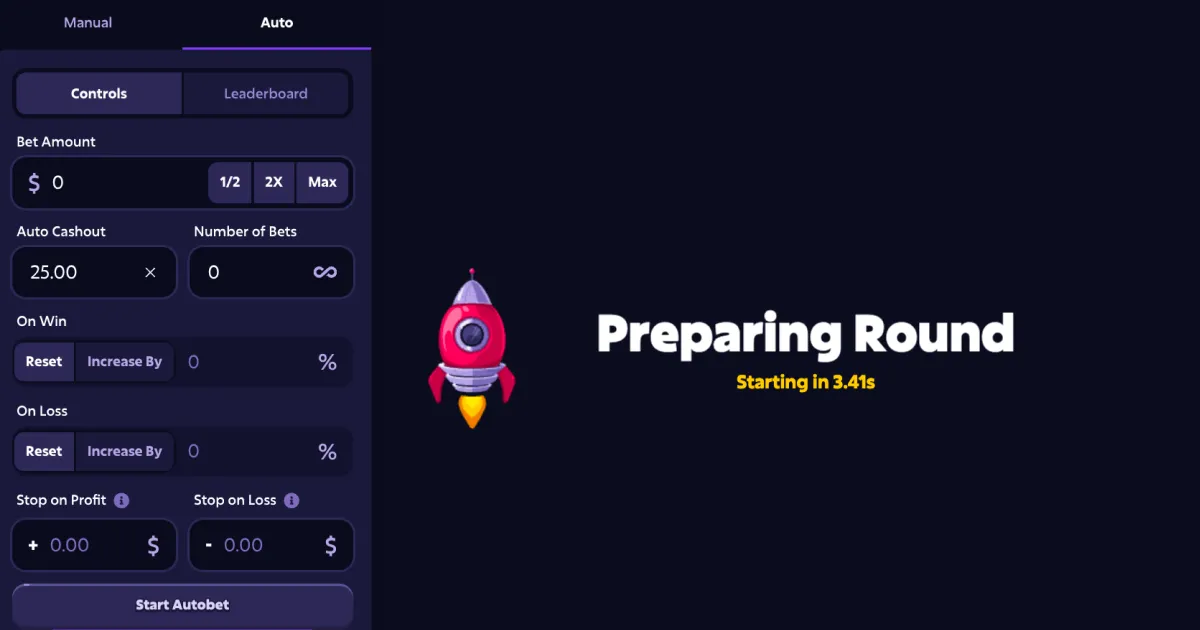
Auto Cashout Strategies for Crash
Autobet in crash games usually gives you the same small set of controls: a base bet, an auto cashout, a fixed number of rounds, simple “On Win / On Loss” bet rules (Reset or Increase by %), plus “Stop on Profit” and “Stop on Loss”. For example, Roobet Crash uses this exact pattern, and so do many other crash games today.
That UI is powerful for simple bet progressions and clear stop rules. But it is not powerful enough for strategies that require memory (sequences), logic based on the actual crash multiplier history, or changing the cashout dynamically.
What Crash Autobet Can And Cannot Do
✅ What it can do well
- Keep a constant bet size and constant auto cashout.
- Increase the bet by a fixed percentage after a win or a loss.
- Reset back to the base bet after a win or a loss.
- Stop after a target profit or a maximum loss.
- Stop after a fixed number of bets.
❌ What it cannot do
- Track a sequence (Fibonacci, Labouchere, Monte Carlo line, etc.).
- Decrease bet size after wins (unless you “Reset”, which jumps straight to base).
- Change Auto Cashout based on outcomes or streaks (unless the UI explicitly supports that).
- Use “if multiplier was below X” rules (pattern-based / history-based logic).
Crash Auto Betting Mode UI
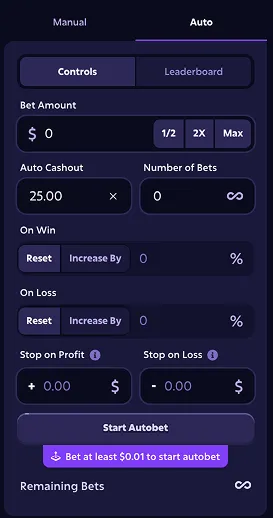
Bet Amount
Your base stake. “Reset” always returns to this value.
Auto Cashout
Your target multiplier. If the round reaches it, you cash out automatically.
Number of Bets
How many rounds autobet will run before stopping (unless a stop condition triggers earlier).
On Win / On Loss
Each has two common options:
- Reset: next bet goes back to Bet Amount.
- Increase By %: next bet becomes current bet × (1 + %/100).
Stop on Profit / Stop on Loss
These are the most important safety rails:
- Stop on Profit: stop when session profit reaches a specific amount.
- Stop on Loss: stop when session loss reaches a specific amount.
Most games calculate these relative to the balance at the moment you press Start, like the Roobet example: start at $100, stop profit $25 → stop at $125. Start $100, stop loss $25 → stop at $75.
Strategies You Can Run With Crash Autobet
Below are the strategies that map cleanly to these controls, with clear setup instructions.
1. Flat Betting
Flat betting means you keep the bet size the same every round. Your results depend only on your chosen Auto Cashout and how long you play. This is the simplest way to use autobet, and it avoids “runaway” bet sizes.
How to set Flat Betting up
- Bet Amount: pick your fixed stake.
- Auto Cashout: pick one multiplier and keep it.
- Number of Bets: optional, set a session length.
- On Win: Reset
- On Loss: Reset
- Stop on Profit: optional, your target session gain.
- Stop on Loss: optional, your maximum session drop.
Just to be clear, flat betting is exactly what the autobet UI is designed to do.
2. Martingale – Loss Progression
A loss progression increases your bet after each loss, aiming to recover previous losses when a win finally happens. In crash, a “win” means the round reaches your Auto Cashout before crashing.
Classic Martingale doubles after a loss. In most crash games, you implement doubling by using Increase By 100% on losses.
How to set Classic Martingale up
- Auto Cashout: choose a fixed target (common examples are around 2.0x, but any fixed value works).
- Bet Amount: your base stake.
- On Win: Reset (go back to base after a win)
- On Loss: Increase By 100% (double)
- Stop on Loss: strongly recommended. This is your “max depth” control.
- Number of Bets: optional, but Stop on Loss is usually the real limiter.
- Stop on Profit: optional, stop after you’re up a chosen amount.
Soft Martingale
Instead of doubling, increase by a smaller percent.
- On Loss: Increase By 20%–80%
- On Win: Reset
This reduces how fast stakes explode, while keeping the “recover after a win” idea.
Martingale strategy depends on your stake not growing beyond what your balance can handle. In this UI, that’s controlled by Stop on Loss and/or a conservative base bet.
3. Paroli – Win Progression
Paroli is the opposite of Martingale. You increase after a win to “press” a winning streak, then reset after a loss. It tries to grow profits during good runs without chasing losses.
How to set Paroli up
- Auto Cashout: fixed target.
- Bet Amount: base stake.
- On Win: Increase By (common values are 25%–100%)
- On Loss: Reset
- Stop on Profit: recommended, because win progressions can spike profits quickly.
- Stop on Loss: still recommended, but typically less stressed than Martingale.
- Number of Bets: optional session cap.
3-step Paroli
If you like a fixed ladder length: increase after wins, but stop the ladder after a few steps. Since the UI may not have “after N wins reset”, you approximate it using:
- Number of Bets as a crude cap, or
- Stop on Profit to exit when the ladder has done its job.
It’s not perfect, but it matches the intent: “press wins, then walk away.”
4. Two-Sided Aggressive Progression
With this strategy you can set both rules to “Increase By %” so the bet grows regardless of outcome. That can be used when you want to accelerate the session in either direction, usually with tight stops.
This is not a “classic” strategy like Martingale or Paroli, but it is something the UI allows.
How to set it up
- Bet Amount: small base.
- Auto Cashout: fixed target.
- On Win: Increase By (small or medium %, e.g. 10%–50%)
- On Loss: Increase By (small %, e.g. 10%–30%)
- Stop on Profit: mandatory.
- Stop on Loss: mandatory.
- Number of Bets: recommended.
Note that this strategy is limited because the UI only grows or resets, you cannot “cool down” after wins except by resetting to base. So this approach relies entirely on stop limits.
5. Chase Profit Strategy
This isn’t a separate progression rule. It’s a session plan: pick any one of the progressions above, then use Stop on Profit to end the run the moment you hit the goal.
This is one of the best uses of this UI, because it turns autobet into a “do X until I’m up Y, then stop” machine.
How to set Chase Profit up
- Choose a base strategy: Flat, Martingale, or Paroli.
- Stop on Profit: set your session target.
- Stop on Loss: set the maximum you are willing to drop.
- Number of Bets (optional): set to prevent very long sessions.
It makes the autobet run automatically, but keeps the session bounded by simple numbers you can understand.
6. Chase Loss Strategy
This is the defensive twin of the previous one. You are not trying to “recover everything”. You are using autobet until a loss threshold is hit, then stopping immediately.
How to set Chase Loss up
- Pick any progression (Flat is the cleanest).
- Set Stop on Loss to a hard limit.
- Optionally set Number of Bets.
- Optionally set Stop on Profit as a “nice surprise” exit.
This is less about squeezing EV out of the game and more about preventing uncontrolled runs.
Strategies That Do Not Fit Crash Auto Betting UI
1. Fibonacci And Other Sequence Systems
Fibonacci betting requires you to move forward and backward along a stored sequence depending on outcomes. The UI only offers:
- Reset to base, or
- Multiply by a constant percent.
It has no memory of “where you are” in a sequence, so Fibonacci, Labouchere, and Monte Carlo line systems cannot be reproduced correctly.
2. True d’Alembert
True d’Alembert is “+1 unit after loss, −1 unit after win.” This UI does not have:
- “Decrease by %”
- “Decrease by units”
- “Step size in units”
You can mimic a feeling of d’Alembert by using a small Increase % on losses, but you cannot implement the key “step down after a win” behaviour unless the UI has explicit decrease controls.
3. Any Strategy That Changes Auto Cashout Over Time
Many strategies are about adjusting the cashout target: playing low targets after streaks, switching to high targets after recoveries, alternating targets, and so on.
4. Pattern-Based Or Multiplier-History Logic
If you want logic like:
- “If the last crash was under 1.2x, do X.”
- “After three reds, switch to Y.”
- “If the last win was big, lower the bet.”
That requires reading the actual crash results and applying conditional rules. Standard autobet UIs don’t have conditional scripting, only fixed multipliers and reset rules.
Ready Presets You Can Copy Into Roobet Crash-Style Autobet
All presets below assume the standard fields listed above.
Simple Flat Strategy
- Bet Amount: 1 unit
- Auto Cashout: 2.00x
- Number of Bets: 200
- On Win: Reset
- On Loss: Reset
- Stop on Profit: 10 units
- Stop on Loss: 10 units
Purpose: predictable, no progression, bounded session.
Soft Loss Progression
- Bet Amount: 1 unit
- Auto Cashout: 2.00x
- Number of Bets: Unlimited (or a large number)
- On Win: Reset
- On Loss: Increase By 50%
- Stop on Profit: 8 units
- Stop on Loss: 20 units
Purpose: chase recovery without full doubling.
Classic Martingale Doubling
- Bet Amount: 0.5 unit (smaller base on purpose)
- Auto Cashout: 2.00x
- Number of Bets: Unlimited (or large)
- On Win: Reset
- On Loss: Increase By 100%
- Stop on Profit: 5 units
- Stop on Loss: 25 units
Purpose: classic “double after loss”, with hard stop.
Conservative Paroli
- Bet Amount: 1 unit
- Auto Cashout: 1.60x
- Number of Bets: 300
- On Win: Increase By 50%
- On Loss: Reset
- Stop on Profit: 12 units
- Stop on Loss: 12 units
Purpose: press wins, avoid chasing losses.
Aggressive Paroli
- Bet Amount: 1 unit
- Auto Cashout: 2.00x
- Number of Bets: 150
- On Win: Increase By 100%
- On Loss: Reset
- Stop on Profit: 15 units
- Stop on Loss: 10 units
Purpose: fast ladder on win streaks, tight loss limit.
Tight Stops With Mild Two-Sided Growth
- Bet Amount: 0.5 unit
- Auto Cashout: 2.00x
- Number of Bets: 200
- On Win: Increase By 20%
- On Loss: Increase By 10%
- Stop on Profit: 6 units
- Stop on Loss: 6 units
Purpose: controlled acceleration, strict session bounds.