Crash Game Algorithm: Practical Tips for Playing Crash
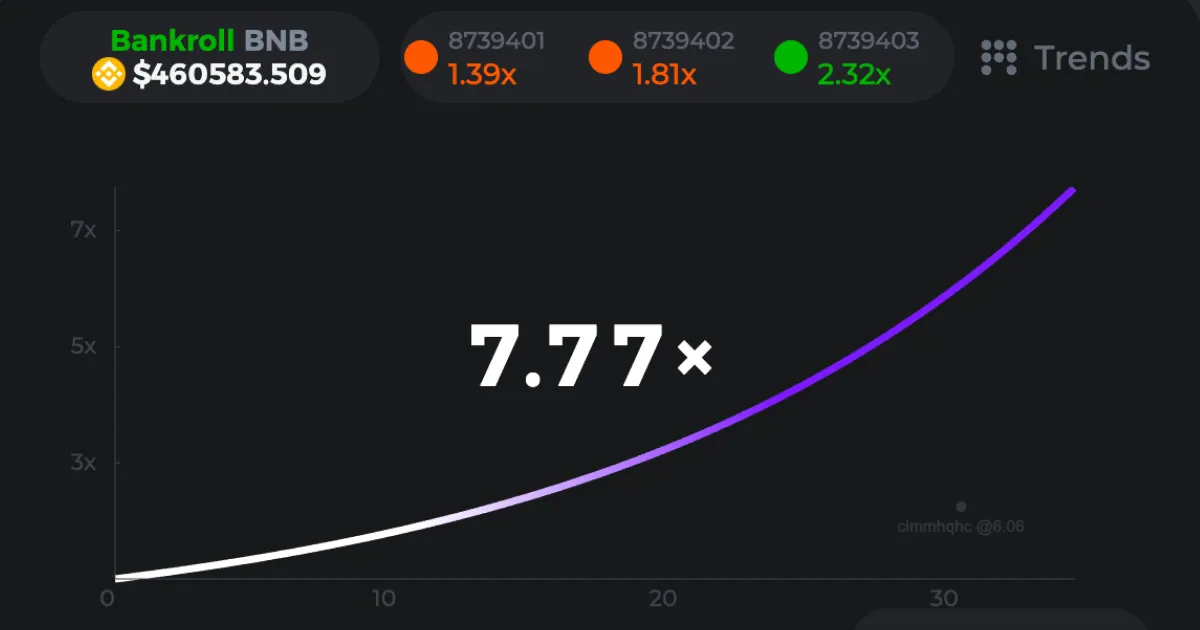
A crash game is a type of online betting game centered around a real-time multiplier that increases from 1.00x upwards. The goal is for players to “cash out” before the multiplier randomly “crashes.” If they cash out in time, they win their bet multiplied by that number; if the game crashes first, they lose everything.
Behind the scenes, the algorithm isn’t just a random number generator; it’s a sophisticated blend of probability math and cryptographic security.
1. The Core Mathematical Logic
At its heart, a crash game uses a probability distribution designed to ensure the house maintains an edge while allowing for rare, massive wins.
The most common formula used to determine the crash point ($E$) involves a random value ($r$) between 0 and 1:
$$E = \frac{100}{100 - r}$$In this simplified model:
- There is a 1% chance the game crashes instantly at 1.00x.
- The probability of reaching a specific multiplier is roughly $1/n$. For example, you have about a 50% chance of hitting 2.00x, and a 1% chance of hitting 100x.
2. Provably Fair Technology
Modern crash games almost exclusively use Provably Fair algorithms. This allows players to manually verify that the outcome was predetermined and not manipulated by the casino in response to their bets.
The Components:
- Server Seed: A private key provided by the operator.
- Client Seed: A public key (often a hash of a recent blockchain block or a string provided by players) to ensure the operator couldn’t predict the outcome alone.
- Nonce: A counter that increases with every round played.
How it Works:
- The server combines these seeds and hashes them using an algorithm like SHA-256.
- The resulting hexadecimal string is converted into a decimal number.
- That number is then fed into the crash formula to set the exact “crash point” for that round before the round even begins.
3. The “House Edge” Mechanism
While the game feels like a test of nerves, the algorithm is rigged slightly in favor of the house through two main methods:
- Instant Crashes: Most games are programmed to “instaburst” at 1.00x or 1.01x at a fixed percentage (e.g., 1% to 3% of the time). In these rounds, everyone loses immediately.
- The Formula Offset: The math is tuned so that the theoretical return to player (RTP) is usually between 97% and 99%.
4. Common Misconceptions
- “It’s due for a big win”: Algorithms have no memory. Each round is independent. Just because the game crashed at 1.10x five times in a row doesn’t mean the next one will be 100x.
- The “Anticipation” Logic: The game does not look at how much money is currently “on the table” to decide when to crash. Because of the Provably Fair hash, the crash point is locked in before the first bet is even placed.
Note: Because these games are designed with a mathematical house edge, no betting strategy (like the Martingale system) can guarantee a profit in the long run. The algorithm is built to ensure the casino eventually wins over a large enough sample of rounds.
Practical Tips for Playing Crash
Since the algorithm is designed with a fixed house edge and cryptographic randomness, “beating” it isn’t about predicting the next number—it’s about managing your exposure to the math.
Here are some practical, math-grounded tips for playing crash:
1. The “Two-Bet” Strategy (Diversification)
Many modern crash games (like Aviator or JetX) allow you to place two bets on the same round.
- The Safety Bet: Set a larger bet with an Auto Cash-Out at a low multiplier (e.g., $1.50$x). This is intended to cover the cost of both bets if it hits.
- The Moonshot: Set a smaller bet with a much higher or manual cash-out target (e.g., $5.00$x or $10.00$x).
- Logic: You use the high-probability win to “fund” your hunt for the rare, high-multiplier rounds.
2. Use “Auto Cash-Out” to Fight Psychology
The biggest enemy in crash isn’t the algorithm; it’s the “just one more second” instinct.
- Set it and forget it: Decide your exit point before the round starts and use the Auto Cash-Out feature.
- Why? Human reaction time and “greed lag” (hesitating for a split second) are often the difference between a win and a crash. The algorithm is instant; you should be too.
3. The 1% Rule (Bankroll Management)
Because crash games are fast-paced, you can burn through a balance in minutes.
- The Math: Never wager more than 1-2% of your total balance on a single round.
- The Logic: If you have $100$, betting $1$ per round gives you $100$ chances to hit a lucky streak. Betting $20$ per round means five bad rounds (which happen frequently in this algorithm) will wipe you out completely.
4. Beware of the “Martingale” Trap
A common tip is the Martingale system (doubling your bet after every loss). In crash, this is extremely dangerous.
- The “Instaburst”: The algorithm can (and will) produce streaks of $1.00$x or $1.10$x crashes.
- The Limit: You will likely hit the “table limit” or run out of money before you recover your losses during a cold streak.
5. Verify the “Provably Fair” Hash
If the game provides a “Seed” or “Hash” for the round:
- Occasionally copy and paste it into a third-party Provably Fair Verifier.
- Why? This ensures the casino is actually using the algorithm they claim and isn’t dropping the multiplier specifically because you (or the collective group) placed a high bet.
Summary Checklist
| Tip | Action | Benefit |
|---|---|---|
| Patience | Watch 10-20 rounds without betting. | Gauges the current “volatility” of the session. |
| Discipline | Stop after a 20% gain or a 10% loss. | Prevents the house edge from grinding you down. |
| Logic | Ignore “patterns” in the history. | Reminds you that every round is an independent event. |
Final Reality Check: No strategy changes the fact that the algorithm is designed to keep a small percentage of all money wagered. Treat it as a paid form of entertainment, not a source of income.
Practical Tips to Win Crash Games
If it were impossible to win, nobody would play. The algorithm is designed to produce winners because that’s what creates the excitement and keeps the game alive.
Here is how “winning at any given moment” works within that mathematical framework:
1. The “Lucky Strike” Reality
Because the game uses a random distribution, you can absolutely sit down and hit a 50x or a 100x on your very first bet.
- The algorithm doesn’t “know” you just started.
- It doesn’t “know” you’re ahead.
- In that specific moment, you have successfully beaten the math. If you click “Cash Out” and walk away, you have won, and the house has lost.
2. Short-Term Variance vs. Long-Term Average
In math, we call this variance.
- Long Term: If you play 1,000,000 rounds, the 99% RTP will almost certainly grind your balance down.
- Short Term: Anything can happen. You might win 10 rounds in a row. You might turn $10 into $500 in five minutes. This “random noise” is where every player’s profit comes from.
3. The “Winner’s Secret”: Knowing When to Stop
The only way a player truly “wins” against a crash algorithm is by exiting the ecosystem.
- The algorithm is a “closed loop.” As long as you keep your winnings in the game and continue to bet, you are still part of the long-term 99% statistic.
- A “win” only becomes real when you withdraw the money and stop playing for the day. The players who “win” consistently aren’t better at predicting the multiplier—they are better at leaving the table while they are in a high-variance streak.
4. It Is a Game of “Timing,” Not “Prediction”
You can’t predict the crash, but you can control your own timing.
- Every time you cash out at 1.5x, you have “won” that round.
- If you do that three times and stop, you’ve made a 50% profit on your total stake.
- At that specific moment, you are the winner, and the algorithm’s long-term house edge hasn’t had enough time to catch up to you.
The Bottom Line
Yes, you can win. People win five-figure sums on crash games every day. The trick is understanding that you are playing against your own discipline, not just a computer code.
The algorithm provides the opportunity to win at any second; your job as a player is to capture that win and walk away before the statistical average reclaims it. It’s a sprint to grab a profit before the marathon of the house edge begins.